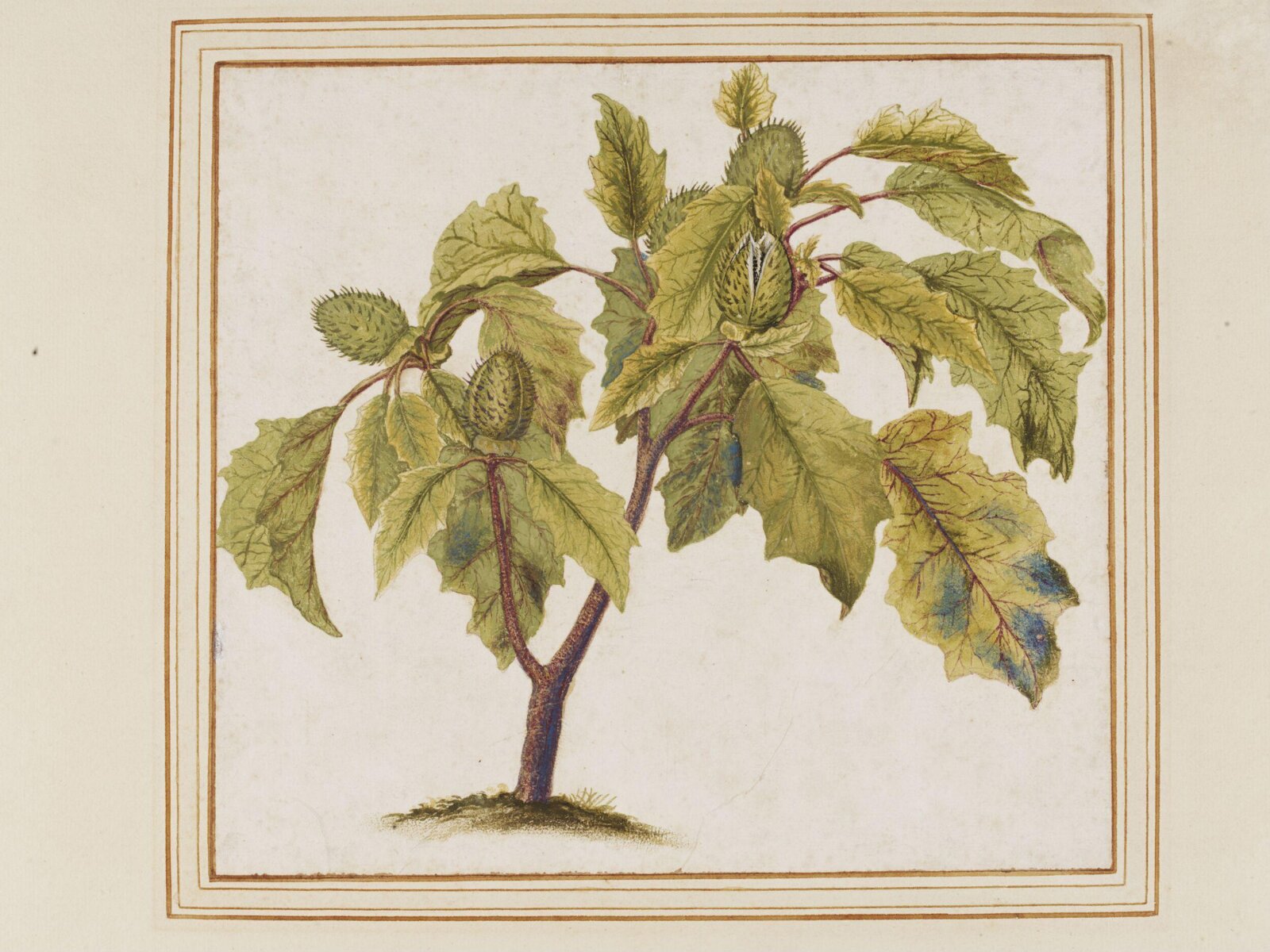
Thorn apple
可否一睹真容?
眼下不见客

维多利亚和阿尔伯特博物馆
倫敦, 英国
仍属馆藏,只是目前没有展出。
- 核实
- 7天前
- 此状态始于
- 2026年9月25日
- 出处
- 博物馆自己的馆藏数据
关于作品
This watercolour is part of the 'Paper Museum' assembled by the 17th-century Roman antiquarian and collector Cassiano dal Pozzo (1588-1657). This was a vast visual encyclopaedia of the ancient and natural worlds, consisting of thousands of drawings and prints. Of roughly 7000 surviving drawings from the Paper Museum, around 2500 are of natural history subjects, including fruit and plants.
Cassiano was a member of Europe's first modern scientific academy, the prestigious Accademia dei Lincei, established in Rome in 1603 - half a century before either the Royal Society in London or the Académie des Sciences in Paris. The Accademia, which numbered Galileo amongst its members, placed great emphasis on observation as the key to unravelling the mysteries of nature.
Read on
For his Paper Museum Cassiano commissioned artists to make drawings directly from specimens; the resulting works were intended to be clear and objective scientific records. Little is known about these artists, due to the documentary bias of the visual encyclopaedia.
Cassiano was interested in the previously unknown species which at this time were being imported to Europe from the Americas, and sought to include them in the Paper Museum. The thorn apple was one such plant. Its white flower, which opens during the night, emits an unpleasant smell, giving rise to the name erba puzzolaor 'stinking plant'. Another name to have become attached to it is mela del diavolo,or 'devil's apple', a reference to its spiny fruits. The plant has hallucinogenic properties.
This drawing was originally contained in one of two volumes of botanical drawings in Cassiano's collection entitled Erbario Miniato. One of these volumes remains in the Royal Collection, whilst the other left the Royal Library in the early twentieth century and the contents dispersed.
维多利亚和阿尔伯特博物馆
作品信息
- 馆藏编号
- E.428-2009
What it shows
已收入目录
出处
- 维多利亚和阿尔伯特博物馆: the museum's own open data · 7天前获取
- 图片: 维多利亚和阿尔伯特博物馆 — © Victoria and Albert Museum, London