
Spanish · 1881–1973
Pablo Picasso
Seven decades of reinvention — the century's restless center of gravity.
- 864
- works indexed
- 44
- on view now
- 4
- institutions
- 2
- countries
Biography
No artist moved the goalposts of art as often as Picasso. The melancholy Blue Period, the circus rose of the Saltimbanques, the shattered planes of Cubism invented with Braque, the neoclassical giants, Guernica's scream — each phase would have been a career for anyone else.
He worked across painting, sculpture, printmaking and ceramics with the same predatory speed, absorbing African sculpture, Iberian carving and the old masters alike. 'I do not seek,' he said. 'I find.'
Identifiers
- Biography: ART MAP editorial. Works and display states: museum collection data.
A life in the collection
Biography events from the ART MAP knowledge graph, interleaved with dated works.
1881
Born in Málaga, Spain; a prodigy trained by his painter father
1901
The Blue Period begins in the wake of a friend's suicide

1901
Le gourmet
On view · National Gallery of Art

1903
The Tragedy
On view · National Gallery of Art
1904
Settles in Montmartre's Bateau-Lavoir; the Rose Period

1904, published 1913
The Frugal Repast (Le repas frugal)
National Gallery of Art

1905
Head of a Woman: Madeleine (Tête de femme: Madeleine)
National Gallery of Art

1906, printed 1933
Bust of Young Woman in Three-Quarter View (Buste de jeune femme en trois quarts)
National Gallery of Art
1907
Les Demoiselles d'Avignon detonates the path to Cubism

1908-1909
Still Life with Fruit Bowl (Nature morte au compotier)
National Gallery of Art

model 1909, cast before 1932
Head of a Woman (Fernande)
On view · National Gallery of Art
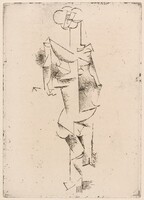
1910
Mademoiselle Léonie, First Plate
National Gallery of Art

1911-1912
Guitarist in an Armchair (Guitariste au fauteuil)
National Gallery of Art

1913
Guitar and Bottle
National Gallery of Art

1914
Still Life with a Glass and Ace of Clubs
National Gallery of Art
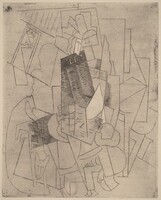
1915, reprinted c. 1947
Man with a Dog (L'homme au chien)
National Gallery of Art

1918
Still Life
On view · National Gallery of Art

1919
Self-Portrait
National Gallery of Art
1937
Paints Guernica in response to the bombing of the Basque town
1973
Dies in Mougins, France, at 91