 Jean DubuffetFrench, 1901–1985
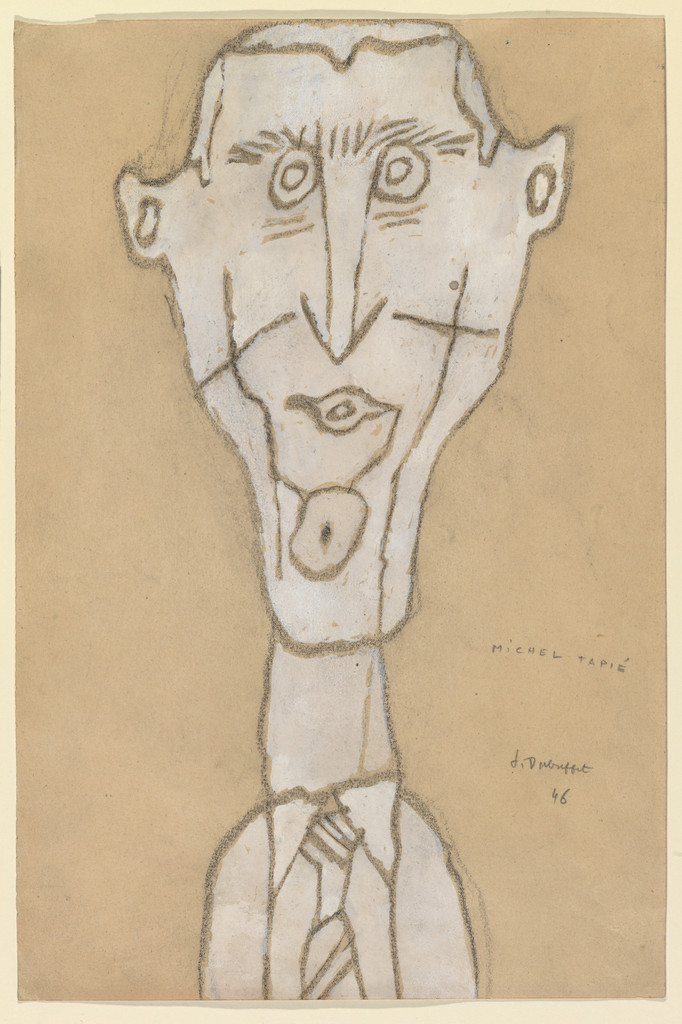
Michel Tapié
May one see it?
Not receiving at present

The Museum of Modern Art
New York, United States
It belongs to the collection, but is not on display at present.
- Checked
- 10 days ago
- Source
- The museum's own collection data
Particulars
- Accession number
- 50.1978
Sources
- The Museum of Modern Art: the museum's own open data · fetched 10 days ago
- Image: The Museum of Modern Art — © the artist or rights holder
Meanwhile, in the life of Jean Dubuffet
The whole lifeOctober 1944
First solo show at Galerie René Drouin
Dubuffet's first solo show opened in October 1944 at the Galerie René Drouin in Paris, marking his third attempt to become an established artist.
1945
He begins collecting art brut
In 1945 Dubuffet began to collect art brut, “raw” art close to the work of children, the self-taught and the mentally ill; the collection is now in Lausanne.
1945
Fautrier's show and the thick paste
In 1945 Dubuffet saw a show of Jean Fautrier's paintings in Paris, in which he recognized meaningful art that expressed the depth of a person directly and purely. Emulating Fautrier, he began mixing thick oil paint with mud, sand, coal dust, pebbles, glass, straw, plaster, cement and tar, and made scratches and slashes in the paste.
1946
Pierre Matisse's New York show: success in America
Dubuffet was included in the Pierre Matisse Gallery exhibition in New York alongside Picasso, Braque and Rouault, one of only two young artists so honored. Clement Greenberg wrote positively about his three canvases, and Newsweek dubbed him the darling of Parisian avant-garde circles.
1947
First solo exhibition in America
In 1947 Dubuffet had his first solo exhibition in America, at the same Pierre Matisse Gallery. Reviews were largely favorable, and he went on to exhibit there at least once a year.
June 1948
The Compagnie de l'art brut is founded
In June 1948 Dubuffet, together with Jean Paulhan, André Breton, Charles Ratton, Michel Tapié and Henri-Pierre Roché, officially established La Compagnie de l'art brut in Paris, dedicated to the discovery, documentation and exhibition of art brut. He later amassed his own collection, including works by Aloïse Corbaz and Adolf Wölfli.