 Paul KleeGerman, 1879–1940
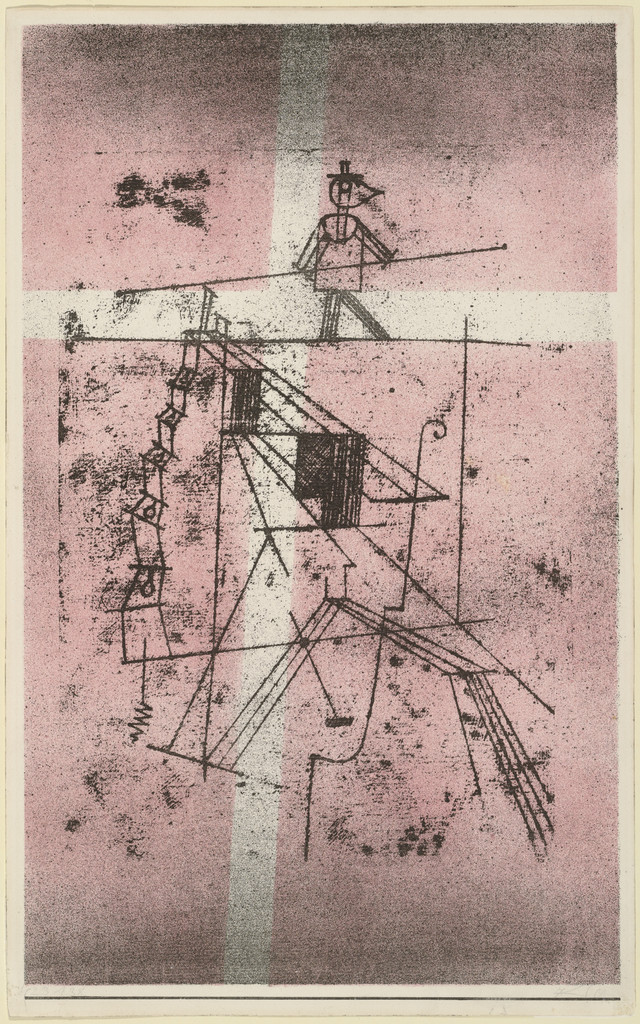
Tightrope Walker
May one see it?
Not receiving at present

The Museum of Modern Art
New York, United States
It belongs to the collection, but is not on display at present.
- Checked
- 10 days ago
- Source
- The museum's own collection data
Particulars
- Accession number
- 3.1931
Sources
- The Museum of Modern Art: the museum's own open data · fetched 10 days ago
- Image: The Museum of Modern Art — © the artist or rights holder
Meanwhile, in the life of Paul Klee
The whole life1921
Walter Benjamin buys “Angelus Novus”
In 1921 the philosopher and critic Walter Benjamin bought Klee’s painting “Angelus Novus”. In his “Theses on the Philosophy of History” he suggested that its angel might be seen as the angel of history.
1921–1931
The preliminary course on the “theory of form”
Klee developed a preliminary course in the “theory of form” that began with the “point as the beginning of all beginnings”, moving through space, and the “cosmic egg” from which line, spiral, square, circle and cube are born. Students listened to lectures illustrated with Klee’s own abstract watercolours and then painted their own, trying to express movement, balance, flight and tension.
1922
Kandinsky joins the Bauhaus
In 1922 Kandinsky joined the Bauhaus staff and his friendship with Klee resumed. Klee welcomed the clash of theories and opinions at the school, approving of such competing forces if the result was achievement.
1923
Galka Scheyer and the “Blue Four”
At the instigation of Galka Scheyer the “Blue Four” was formed — Klee, Kandinsky, Lyonel Feininger and Alexej von Jawlensky. Scheyer subsequently organised exhibitions of their work in the United States.
26 January 1924
The lecture “On Modern Art” in Jena
At his exhibition at the Kunstverein in Jena Klee delivered the lecture “On Modern Art” (Über moderne Kunst).
1924–1925
Success with the Paris Surrealists
In 1924 Klee exhibited in Paris for the first time and became a hit with the French Surrealists, who were drawn to his partly morbid motifs. At the Paris Surrealist exhibition of 1925 Max Ernst was impressed by his work.